Course 4: Session 7
THE PERIOD OF THE
CONQUEST AND JUDGES
1406-1051BC
The Book of Joshua
- Title
Yahweh saves (Greek is Jesus) - Theme
Canaan represents God’s inheritance, given to the believer and claimed by faith. The Victorious Christian life is a life of battles and blessings, but it is also a life of rest. (Heb. 4-5) make it clear that the entering of the nation into Canaan is a picture of the believer entering into a life of rest and victory through faith in Christ.Egypt The Wilderness Canaan Picture Of the World Picture Of the Defeated Picture Of Victory Bondage To Sin Christian Life Wandering Claiming Inheritance The Natural (Unsaved) The Carnal (Fleshly) The Spiritual The Burden of Sin The Defeat of Unbelief The Victory of Faith - Parallels with Moses
Holy ground experience (Josh. 5:13)
Parted waters (Josh. 3:13-17)
God buries Moses, but His work goes on (Josh. 1:1-11) - Joshua the Man
He was born in Egyptian slavery. His father’s name is Nun, of the tribe of Ephraim. Moses changed his name to Joshua. He was Moses’ minister during the wilderness. He led Israel in the battle with Amalek. He was one of two spies who had the faith to enter Canaan. He, along with Caleb, was allowed to enter the land. Tradition says he was 85 years old when he took Moses’ place. The conquest took about 7 years. (Josh. 1-12) (Josh. 13-24) Joshua divides the land. He died at age 110. (Josh. 24:9)Joshua is a type of Christ. Just as Joshua conquered his enemies, Christ has defeated His enemies. Jesus led us into spiritual battle and victory. Joshua also assigned the people their portion of the inheritance. - Major Teachings
- Faithfulness of God – Gave the land He promised.
- Presence of miracles – Three periods of miracles.
- Days of Moses and Joshua.
- Days of Elijah and Elisha
- Days of Jesus and the apostles.
- Three Miracles of Joshua
- Crossing of the Jordan
- Walls of Jericho
- Sun Standing Still
- Conquest of the Land
- Person of Rahab – Illustrates how God can use anyone. When Rahab married into Israel, she married Salma, whose father, Naheson, was the prince of the tribe of Judah. She is recognized in (Heb. 11:31) as a person of faith.
- The Miracles of the Crossing – Similarities in Crossing the Red Sea
The Red Sea The Jordan River Delivered From Egyptian Bondage Brought Them into Canaan Separation From Egypt Dedication To God Christ’s Death for Us Our Death with Christ The Enemy Defeated Finally Daily Victories by Faith
- Highlights of the Book
- Before they could go into battle, the men had to be circumcised. This had been neglected while in the wilderness (Josh. 5)
- The Captain of the Host (Josh. 5:13-15)
Christophany - The Fall of Jericho (Josh. 6)
- Disobedience of Achan (Josh. 7)
- Destruction of Ai (Josh. 8)
- Deception of Gibeonites (Josh. 9)
- Sun stands still (Josh. 10)
- Joshua’s final address to the people (Josh. 11)
Notes
The Book of Judges
- Author
The book does not identify, but Jewish tradition assigns it to Samuel - Theme
Lose tribes without a real government that looked to God for a leader. These are Israel’s darkest days. Everyone did what was right in their own eyes. - Chronology
About 410 years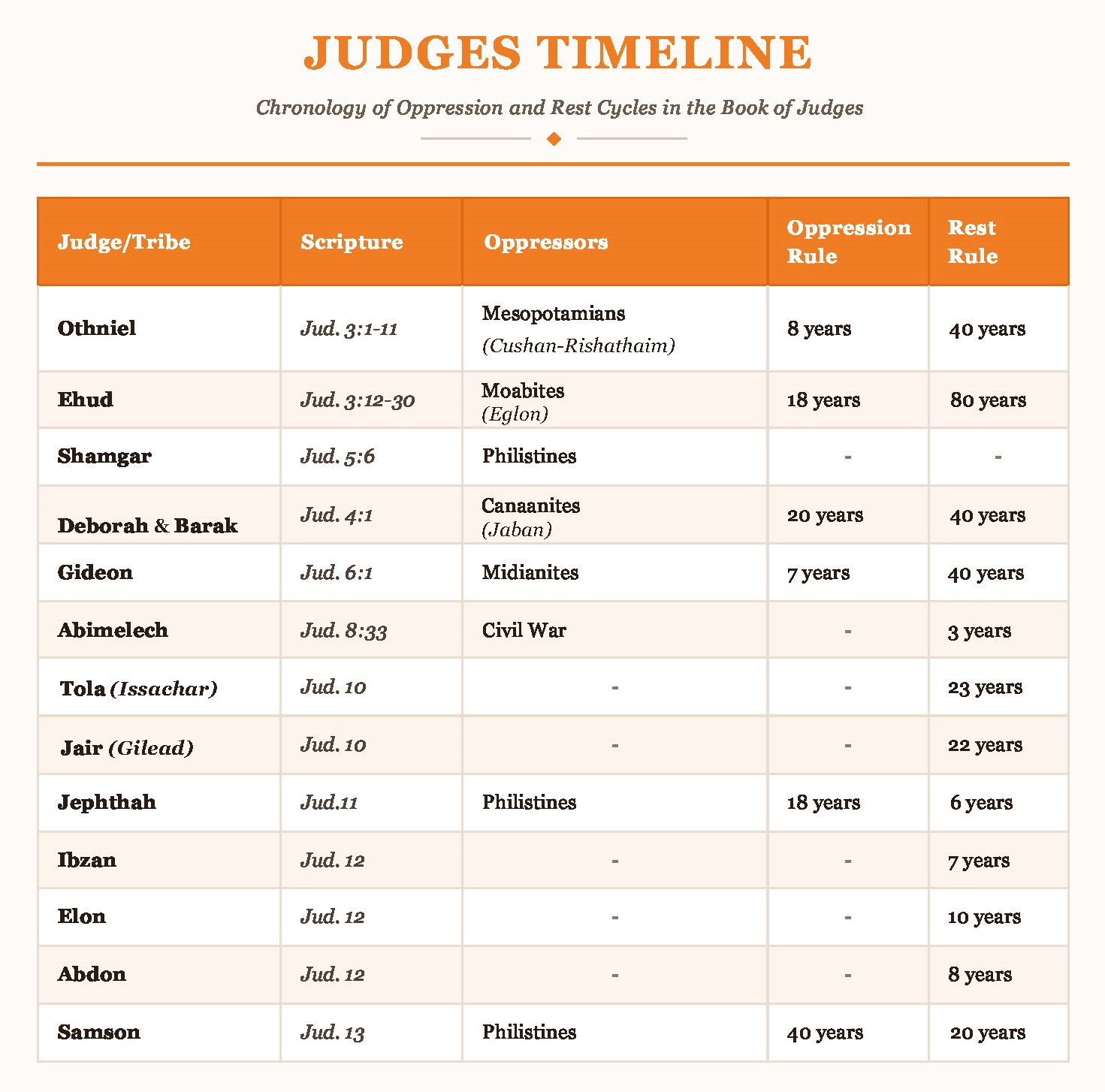
- Four Judges Are Listed in Hebrews 11 For Their Faith
Gideon, Barak, Samson, Jephtha - Why Was There a Decline?
- People were spread out and did not worship together
- Faith was not taught in homes
- Intermarriage with non-Israelites
- After Joshua, there were no spiritual leaders
Notes
The Book of Ruth
- Author
Unknown, but tradition says, Samuel
Ruth and Esther are the only two books named after women - Date
Period of Judges, and most likely during Gideon - Major Teachings
- Kinsmen Redeemer
- Ruth is set between Judges and Samuel for a reason
- Judges show a Decline
- Samuel shows the setting up of a Jewish Kingdom
- Ruth shows Christ and His bride; He is our kinsman redeemer
- Ruth is brought into the Jewish nation and becomes the ancestor of David
- Kinsmen Redeemer
- If a man was forced to sell his property, his kinsman redeemer would bail him out.
- If a man was sold into slavery, the nearest kin were to buy his freedom.
- If a man died, his brother took in his wife to keep the family name.
- If a man died at the hand of another man, the kinsmen acted as avengers of blood. (Gal. 3:13)
- Significant Passage
(Ruth 1:16) - The Book Begins with a Funeral and Ends with a Wedding
- Author
Notes